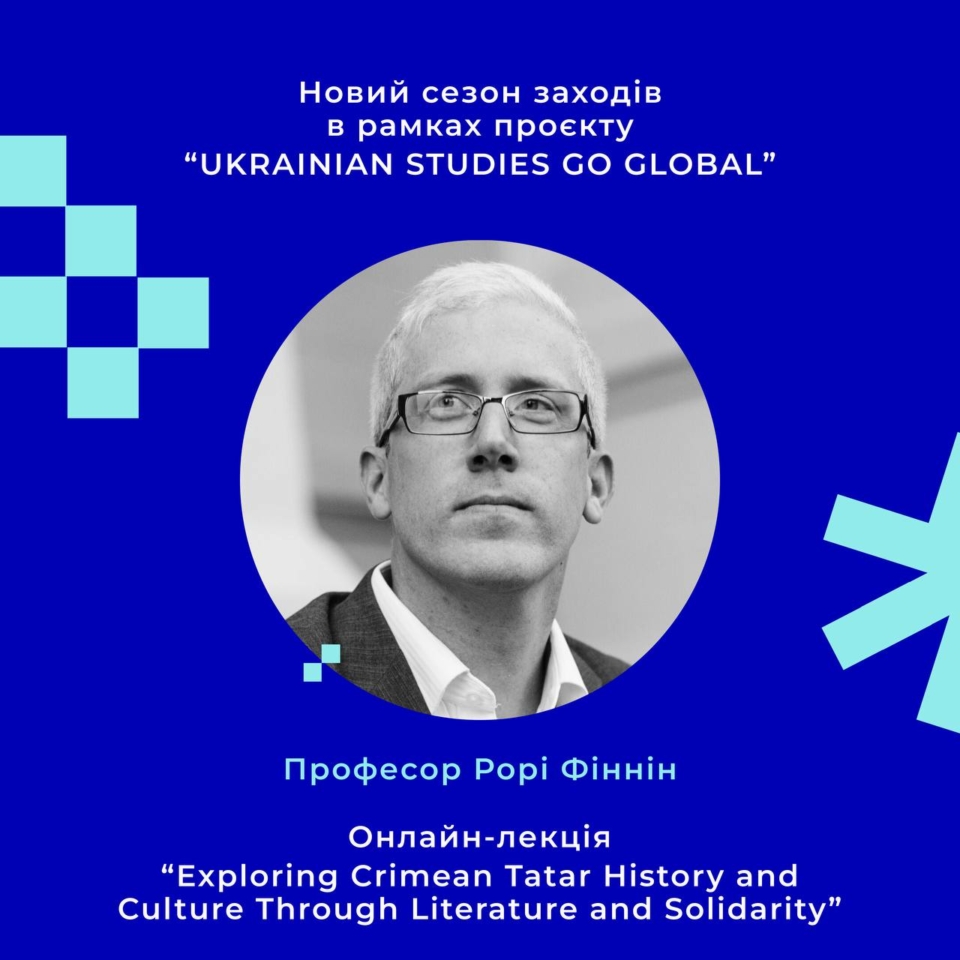
A new season of events within the ‘Ukrainian Studies Go Global’ project opens with an online lecture by Cambridge professor Rory Finnin
The Foundation of the President of Ukraine for the Support of Education, Science and Sports has initiated the project ‘Ukrainian Studies Go Global’, aimed at uniting scholars from international academic centers studying Ukraine.
As part of the project, online meetings, lectures and discussions between Ukrainian and foreign researchers on the topic of Ukrainian studies in various aspects will be held throughout October and November: literature, history, culture, politics of memory.
The first event that opens the Ukrainian studies season will be an online lecture by Cambridge professor Rory Finnin on the topic ‘Exploring Crimean Tatar History and Culture Through Literature and Solidarity’ for Ukrainian students.
As part of the online lecture, Professor Rory Finnin will share the results of his research, which is reflected in the book “The Blood of Others: Stalin’s Crimean Crime and the Poetics of Solidarity,” published in March 2022.
The lecture will be moderated by Roman Nazarenko, Director of the Institute of Religion and Society of the Ukrainian Catholic University.
• Date and time: October 19 at 7:00 PM.
• Language of the event: English.
• Format: online, Zoom. (To receive a link to Zoom, please register at this link: https://bit.ly/rori-finnin)
The online lecture is organized at the initiative of the Foundation of the President of Ukraine for the Support of Education, Science and Sports.
Academic partner of the event: Ukrainian Catholic University.
Partners: Representative Office of the Friedrich Naumann Foundation for Freedom in Ukraine, NGO “Center for Political Studies and Analytics “Eidos”, Representative Office of the President of Ukraine in the Autonomous Republic of Crimea, National Office “Crimean Platform”, Department of Turkology of the Educational and Scientific Institute of Philology of Taras Shevchenko National University of Kyiv.
About ‘Ukrainian Studies Go Global’:
After the collapse of the USSR, the Western academic community changed the direction of its activities, transforming centers of Soviet studies into centers of post-Soviet/Slavic studies. Unfortunately, many of these institutions continued to adhere to Russia-centric views, analyzing the countries of the post-Soviet region through the prism of the Russian perspective.
The outbreak of the war in Ukraine in 2014, which resulted in a full-scale invasion in 2022, once again highlighted the shortcomings and inappropriateness of such an approach. Currently, in many Slavic academic institutions, issues of “internal decolonization” and the need to strengthen Ukrainian studies are actively discussed. Understanding Ukraine in the modern light is becoming as important as ensuring international security.